|
Proceedings of the American Society for Municipal
Improvements Convention held at ST. Louis, MO. OCTOBER
12, 13, 14, 15, 1920
VALPARAISO, INDIANA
CHARLES CARROLL
BROWN SECRETARY
SUGGESTIONS FROM
FRENCH PRACTICE IN MUNICIPAL IMPROVEMENTS
By George B. Ford, Director of City Planning Department
of the Technical Advisory Corporation, New York City
I wish you would take a trip to-day
thru northern France. It is one of the most inspiring
things you could do. The French are coming back. We knew
they would, but their achievement in the face of the
most appalling destruction the world has ever seen is
astounding.
An area as big as Massachusetts, Rhode Island and part
of Connecticut was laid waste, but already two-thirds of
it is back under cultivation. More buildings were
destroyed than in the whole of Greater New York and yet
not only is almost everything repairable back in use but
complete reconstruction is well underway. Three-quarters
of the factories are again in operation.
Enough miles of railroad were destroyed to reach from
New York to San Francisco, but almost all is not only
back in use but is handling much more freight than
before the war. 1800 bridges were destroyed. Almost all
are rebuilt and better and more modern than before the
war. They are profiting by the destruction of several
hundred miles of canals to prepare them to take 600-ton
barges instead of 300 tons. Whole mountain-sides are
being blasted away to repair the destroyed tunnels, and
great arched concrete retaining embankments are being
constructed.
In their haste to get back on their feet are they just
putting back what was there before the war ? Far from it,
they are profiting by the occasion to correct the
mistakes of the past and to start fresh.
Chauny was a knee-high town blown up systematically by
the Germans because it was an important industrial city
; a menace to German trade. La Renaissance des Cites
held a competition for plans for its improvement. The
remarkable prize plan has been officially adopted by the
city. It creates a large factory-district between the
railroad and the canal with workingmen's model home
communities within easy walking distance.
Soissons, always under fire during the war, is profiting
by the destruction to replace some of her tortuous
streets by broad traffic arteries. Arras, Verdun,
Cambrai, etc., are doing the same.
Lille, the great industrial center of northern France is
tearing down her choking walls and changing her terminal
passenger-station into a modern thru station and now she
is holding a great competition for the planning of all
of the contributing area.
Rheims is the first city in France to have its
comprehensive city plan adopted by the French Government.
In these plans I have
|
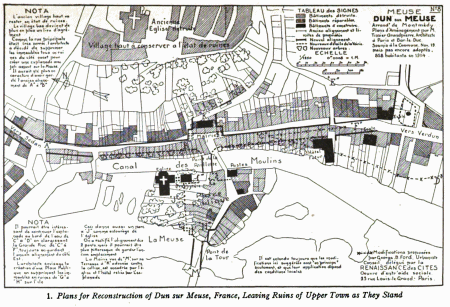
NOTA
L'ancien village haut va rester en état de
ruines. Le village bas devient de plus en plus
un lieu d'agrément. Comme la rue principale
était très serrée, l'architecte a décidé de
supprimer les immeubles tous en ruines du côté
ouest pour créer une esplanade ave joli aspect
sur la Meuse.
Il aurait le plus en caractère d'avoir gardé
l'ancien alignement de « A » à « B ».
NOTA Il pourrait être intéressant de continuer
l'esplanade au bord de l'eau de « C » à « D » en
élargissant la Grande Rue de « C » à « F »
toujours en gardant l'ancien alignement du côté
Est.
L'architecte envisage la création d'une Place
Publique en supprimant les immeubles en ruines
de « G » à « H » sur l'ile.
Ceci donne aussi un parc à « J » comme entourage
de l'église On a rectifié l'alignement des 2
ponts mais il pourrait être plus pittoresque de
garder l'ancien emplacement.
La Mairie vue de "M" sur sa Terrasse à « K »
adossée contre la colline, est encadrée par
l'église et l'hôtel reliés par l'esplanade
1. Plans for Reconstruction of Dun sur Meuse,
France, Leaving Ruins of Upper Town as They
Stand |
provided for large industrial districts along the
railroads and the canals radiating from the center of
the city and alternating with workingmen's living
districts also radiating. An ample playground was
attached to every school by appropriating the centers of
deep blocks. Parks and connecting boulevards were
distributed around the outskirts. Community-center
buildings and public markets were located within easy
reach. Public and semi-public buildings were given an
adequate setting. Many of these ideas and others that we
have come to think of as necessities in America were new
to them but they are open-minded and want to do the
right thing. The city engineers are often the quickest
to grasp the new possibilities and the most zealous to
push them.
Marseilles and Limoges are wiping out large slum areas
and making them into the show quarters of the city.
Lyons, the silk city, has built a great bridge and a big
public hospital during the war and is now working on a
sewer system and 10,000 workingmen's homes.
Paris has just held a great competition for a
comprehensive city plan for all of the surrounding
territory. As a member of the jury, I was most struck by
the vision with which the judges approached their
problem.
What is there in this record that interests us? First
and foremost the great fact that France, the first of
all countries in the world, voted on March 14, 1919, a
compulsory city-planning law by which every city over
10,000 inhabitants must make a comprehensive plan for
its improvement and every devastated town and village no
matter how small - and there are 2,600 of them - must
make a plan for better sanitation, circulation, open
spaces, housing, etc., before any permit for any
reconstruction can be given.
Already over a thousand towns have their plans and
already the State has approved several hundred of them.
One and all they are profiting by the occasion to
correct the mistakes of the past and to modernize their
towns without losing their character, altho I had much
ado to persuade some of them not to adopt our nightmare
American gridiron plan, which so rubber stamps our towns.
Then they have excellent expropriation laws. It was just
five days before the armistice that they adopted a most
useful excess-condemnation law; but for years their laws
have permitted them to lay out streets on the map in the
bed of which the owner can build only at his own risk
and the city assesses benefits and awards damages only
when it is ready to expropriate.
Furthermore, for many years they have been widening
streets all over France by the same process that has
been used in widening Chestnut and Walnut streets in
Philadelphia, that is by striking a building line a
given number of feet back from the old street line and
then requiring every property owner on rebuilding to set
back to the new line. Fully one-third of the streets of
old Paris are being widened to-day by this means. As
benefits are assessed at
|
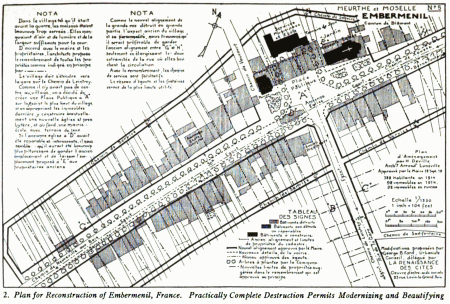
NOTA Dans
le village tel qu'il était avant la guerre, les
maisons étaient beaucoup trop serrées. Elles
manquaient d'air et de lumière et de la largeur
suffisante pour la cour.
D'accord avec le maire et les propriétaires,
l'architecte propose le remembrement de toutes
les propriétés comme indiqué en principe par . _
. _ .
Le village doit s'étendre vers la gare sur le
Chemin de Leintrey.
Comme il n'y avait pas de centre au village, on
a décidé de créer une Place Publique à « A » sur
le point le plus haut du village et en
expropriant les immeubles derrière y construire
éventuellement une nouvelle église et
presbytère, et au fond, une mairie-école avec
terrain de jeux.
Si l'ancienne église à « D » avait été réparable
et intéressante, il nous semble qu'il aurait été
beaucoup plus pittoresque de garder l'ancien
emplacement et de laisser l'emplacement proposé
à « E » aux propriétaires anciens.
NOTA Comme le nouvel alignement de la grande rue
détruit en grande partie l'aspect ancien du
village et sa personnalité, nous trouvons qu' il
serait préférable de garder l'ancien alignement
entre « G » et « H », seulement en élargissant
le deux extrémités de la rue où elles bouchent
la circulation.
Avec le remembrement, les chemins de service
sont facultatifs.
Le réseau d'égouts et les fontaines seront de la
plus haute utilité
2. Plan for Reconstruction of Embermenil,
France. Practically Complete Destruction Permits
Modernizing and Beautifying |
the same time damages are awarded, the city, in the long
run, secures the widening for a very small outlay.
In 1902, France passed an excellent permissive health-law
giving cities the right to appoint health boards and to
adopt sanitary codes for which the Government furnished
a model form. The famous war-damage act, by which the
Government pays all war-damage in full, also provides
that all devastated towns and villages must be made more
sanitary and that the government will pay a large part
of the cost. The result is that water-and sewer-systems
are appearing all over northern France.
On workingmen's housing the French Government has been
loaning money for many years at two percent interest
amortizable in not over 25 years. They loan it to a city
bureau or to a housing company on condition that they do
not charge over 400 to 936 francs rent, depending on the
location and the size of the suite and in no case more
than 4 3/4 percent of the cost of land and building. The
government lends from 60 to 80 percent of the total cost
and private capital invested in the balance must not pay
over four percent. The tenant pays from 2 1/4 to 3 1/2
percent per annum where he rents and 1/5 down and from 2
to 2 1/2 percent per annum where he buys. Taxes on new
housing are remitted for 12 years. Special inducements
are given to the needy, to large families, and for the
purchase of small farms.
A new bill now before the French parliament provides
that the Government shall give outright one-half of the
cost of land and buildings with a view to the erection
of 500,000 workingmen's homes in the next ten years.
The French have always been famous for their roads,
mostly macadam with a very thin top crust. They have
stood the inevitable neglect of the war remarkably well.
Everywhere in the devastated region they are being
rebuilt. They rarely use our tar binders and our oils
but they are beginning to use our concrete roads. In
Paris, everywhere except on the hills, they are using
wood blocks.
Their canals and railroads in the devastated regions
have come back with astounding rapidity, but their great
contribution is their light narrow-gauge railways that
ramify all over the country. These use light rails and
virtually no grading. They proved of inestimable value
during the war.
here were no community centers in France before the war,
but today there are at least four national societies
organizing them thruout the devastated regions. The idea
is taking hold rapidly, often starting as a workingmen's
club. They serve as an excellent counteractive for the
saloon.
Beauty and charm has always characterized the French
towns and villages. They are apt to place that which is
offensive to the sight before that which is offensive to
the sense of smell or of hearing. They insist that their
towns shall be attractive, often invoking the police
power to that end. The interesting part of it is that it
costs little, if any, more than it would if they didn't
insist. They appreciate the fact that attractiveness in
their surroundings is an economic asset. It pays.
Finally, to realize their plans the French have
developed vastly of late the principle of "co-operation."
Over 1,000 reconstruction co-operative societies have
been founded in the devastated regions, several villages
often combining in one. Each society, aside from
encouragement from the Government, profits by all of the
savings entailed in having only one architect and one
contractor for the whole group, who buy in quantity and
ship in quantity, who can organize large shops, burn
their own brick and lime and standardize everything that
goes into the buildings.
However, the great outstanding contribution of France is
the fact that she now realizes that her towns and
villages must plan ahead and private property rights
must be controlled for the public good. The war has
borne in upon her that mistakes of the past must be
corrected. She realizes that she owes it to the citizens
of the future to plan for them healthy, convenient,
comfortable, charming places to live and work in. |



